
소식
_page-0001.jpg)
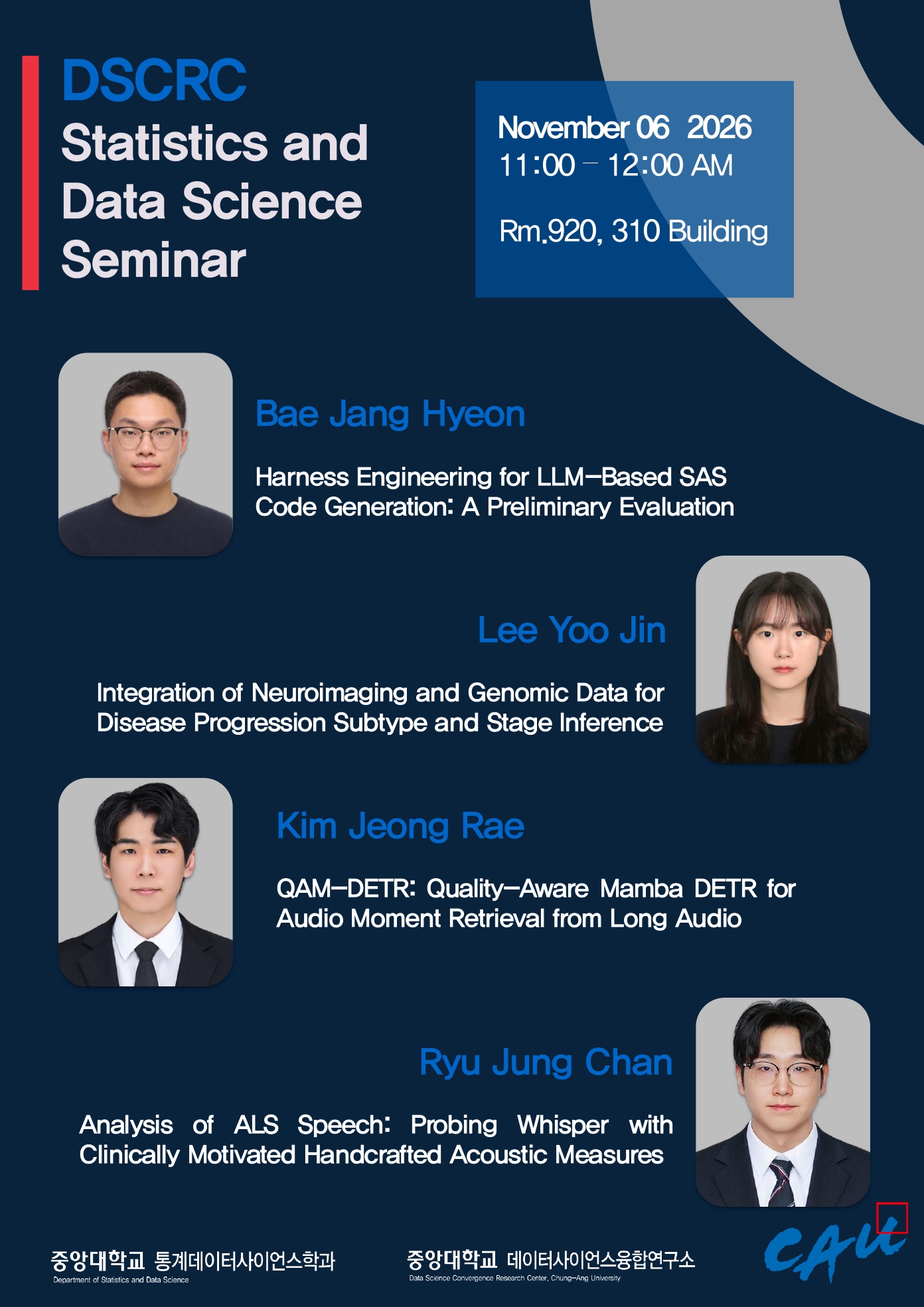
중앙대학교 데이터사이언스융합연구소에서 2026년 11월 6일 Seminar를 개최합니다.
연사 : 4 Graduate Students, Department of Statistics and Data Science, Chung-Ang University
일시 : 2026년 11월 6일 11:00-12:00 PM
장소 : 310관 920호
- 1. Bae Jang Hyeon Ph.D. Candidate Department of Statistics and Data Science, Chung-Ang University
Harness Engineering for LLM-Based SAS Code Generation: A Preliminary Evaluation
Translating research protocols into SAS code for the Korean National Health Insurance Service (NHIS) data requires accurate interpretation of eligibility criteria, temporal definitions, and database structures. Although large language models (LLMs) offer opportunities for automated code generation, ensuring consistency with research specifications remains challenging. This study aims to develop and preliminarily evaluate a harness-engineered LLM framework for generating SAS code from structured NHIS research protocols.
We developed a Python-based framework integrating structured protocol parsing and summarization, clarification of ambiguous research definitions, deterministic SAS scaffolding, LLM-based code generation, and iterative validation and repair. Research protocols prepared in Microsoft Excel are transformed into structured research specifications before code generation. Database schemas and predefined processing rules are incorporated to guide SAS code generation for cohort construction.
The preliminary experiment includes three research protocols and three framework configurations: the complete harness, a configuration without validation–repair, and a configuration without scaffolding or validation–repair. Each configuration is designed to generate SAS code five times per protocol. Generated programs are evaluated against manually established gold-standard research specifications and reference SAS programs to identify discrepancies in research logic, database consistency, and code validity.
Subsequent evaluation will include execution-based comparisons and a broader ablation study examining individual harness components. The preliminary evaluation is ongoing, and quantitative results will be incorporated following completion of code generation and independent validation.
This study introduces a structured framework for translating NHIS research protocols into SAS code by separating protocol interpretation, deterministic processing, LLM generation, and validation. The proposed evaluation is intended to characterize generation errors and assess the contribution of harness components to research-oriented code generation.
- 2. Lee Yoo Jin M.S. Candidate, Department of Statistics and Data Science, Chung-Ang University
Integration of Neuroimaging and Genomic Data for Disease Progression Subtype and Stage Inference
Neurodegenerative diseases such as Alzheimer’s disease and Parkinson’s disease show substantial heterogeneity in progression rates and patterns of brain structural changes, complicating early diagnosis and personalized treatment. Subtype and Stage Inference (SuStaIn) was developed to infer disease subtypes and stages from cross-sectional brain imaging data. In this study, we propose a framework that integrates genetic information into the SuStaIn model to explain inter-individual differences in disease progression. Three extensions were considered: a Gene-prior Model, incorporating genetic effects on subtype assignment; a Gene-dependent MRI-shift Model, modeling genetic associations with reginoal MRI variation; and a Joint Model, accounting for both effects.
We evaluated these models using simulation studies and an application to cross-sectional MRI and genetic data from the Alzheimer’s Disease Neuroimaging Initiative (ADNI). The Joint Model achieved the highest cross-validated log-likelihood, indicating the best fit among the three models. APOE showed substantial effects on both subtype assignment and regional MRI phenotypes, with a positive association with Subtype 2, characterized by early temporal, frontal, and insular atrophy, and with higher MRI z-scores in the temporal, frontal, pallidum, and insula regions.
This framework provides a genetic interpretation of heterogeneous disease progression patterns and may support precision medicine approaches for disease progression prediction and developing subtype-specific treatment strategies.
3. Kim Jeong Rae Ph.D. Candidate Department of Statistics and Data Science, Chung-Ang University
QAM-DETR: Quality-Aware Mamba DETR for Audio Moment Retrieval from Long Audio
This paper presents QAM-DETR, our system for DCASE 2026 Challenge Task 6: Audio Moment Retrieval from Long Audio. The task requires localizing the temporal segment in a long audio recording that best matches a given natural-language query. Unlike clip-level audio-text retrieval, audio moment retrieval demands precise boundary prediction, long-range temporal modeling, and reliable ranking of candidate moments.
QAM-DETR builds on a DETR-style moment localization framework using frozen pretrained audio and text representations. LAION-CLAP is used as the primary audio-language representation, while MS-CLAP, WavLM, and RoBERTa features are selectively integrated through lightweight learnable gates to exploit complementary acoustic and linguistic information. To improve query-conditioned temporal localization, the proposed system introduces 3-way cross-attention-based cross-modal fusion, a BiMamba-based bidirectional temporal encoder, lightweight multi-scale temporal fusion, and a quality prediction branch for candidate ranking. For selected final submissions, a frozen audio-language LLM verifier is further used as a post-processing re-ranker, which re-scores candidate segments without modifying their predicted temporal boundaries or updating model parameters.
Experiments on the CASTELLA development splits show that the proposed components consistently improve the DETR-style baseline, with BiMamba temporal encoding and quality-aware ranking providing substantial gains. Final ensemble systems further improve retrieval performance by combining diverse feature configurations and, in selected variants, LLM-based candidate re-ranking. The final system achieved joint first place in DCASE 2026 Task 6, demonstrating the effectiveness of quality-aware temporal modeling and candidate re-ranking for long-audio moment retrieval.
4. Ryu Jung Chan M.S. Candidate, Department of Statistics and Data Science, Chung-Ang Universit
Task-Wise Probability Fusion for Follow-Up Speech Severity Prediction in ALS: Sensitivity to Input Composition and Vowel–DDK Weighting
This study compared the performance of different input feature configurations and probabilistic weighting schemes for vowel and DDK task groups in predicting subsequent speech severity in patients with amyotrophic lateral sclerosis (ALS). We used 130 patients and 1,040 recordings from Task 2 of the ICASSP 2026 SAND Challenge to construct four input configurations comprising Whisper representations, metadata, and acoustic features. For each configuration, XGBoost classifiers were independently trained for each of the eight speech tasks and evaluated using patient-level nested cross-validation.
Subsequently, using the stored out-of-fold (OOF) prediction probabilities, we calculated the average probabilities for the five vowel tasks and three DDK tasks separately. The relative weight assigned to the DDK group was then varied from 50% to 90% in increments of 5 percentage points. When the two task groups were combined with equal weights (50:50), the Macro-F1 scores were $0.6009 \pm 0.0259$ for the Whisper and metadata configuration and $0.6024 \pm 0.0364$ for the full-feature configuration. The addition of metadata yielded the largest performance improvement, while the effect of varying the DDK weight differed across input configurations. Under the full-feature configuration, 24–27 patients were correctly classified only by the DDK group, while 9–12 patients were correctly classified only by the vowel group, depending on the training seed.
Because the combination weights and reporting seed were selected after examining the OOF results, differences in performance across weighting schemes were interpreted as exploratory findings.